
I agree fighter. In my initial skepticism, I was lazy, and failed to read the situation properly.
However, as its been a debated topic, I went back to the original posting and have a re-read it.
i now agree that switching increases your probability of winning, but doesnt guarntee it
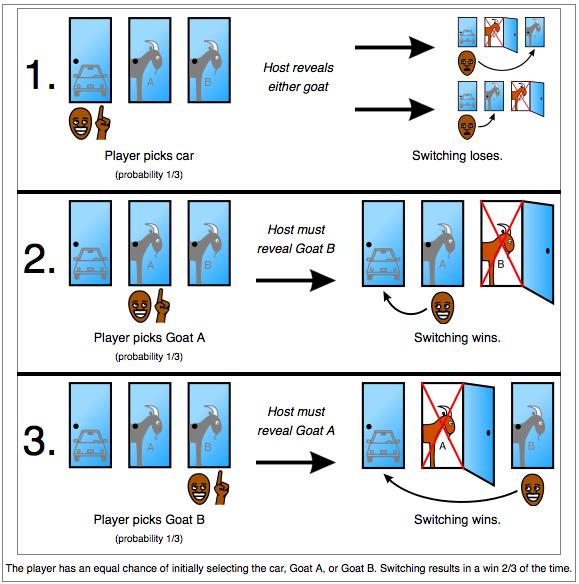
but it should be understood that if you did choose the car first up (and of course, you don't know this), and still switched, then switching guarantees you loose.
Of course, if you chose the car initially, then switched and lost, you will be the laughing stock of the whole world, even if your choice to switch was statistically better
-
I think another problem the naysayers are having in accepting that switching is a better option is that they are assuming the two selections are independent events.Originally posted by The_Hawk View Post
By way of explanation, flip a coin two times, and the result of the second flip is independent of the first (meaning it wasn't influenced in any way by the first), and hence the odds are 50/50 each time.
Next consider trying to pick the ace of spades from a well shuffled deck of cards. The odds for this would be 1 in 52. If you replace the card, shuffle and pick again, the odds remain 1 in 52, making the selections independent. If you do not replace your initial selection, the odds shorten to 1 in 51 (assuming your first selection wasn't the ace of spaces of course), as the loss of one card creates a dependency between the two selections, which affects the odds on the second selection.
The Monty Hall problem isn't a case of independent events, as Monty eliminates one of the doors, creating a dependency between the two selections. This is especially so as Monty isn't eliminating a door at random, but rather knowingly eliminating a goat. This means this doesn't remain a case of random probability, but instead turns into one of conditional probability.
This answer is easily demonstrated at home with the help of a friend, so there is an opportunity for those who doubt its veracity to try it and see for themselves. The more you do the exercise the more the results of switching will indicate a win 67% of the time (meaning that if you did the exercise, say, 100 times, about 67 times out of the hundred times you did it you would have won the car by switching. I'm not suggesting that you need to do it this many times to see the trend though).Leave a comment:
-
yeah, i constantly refer to the OP as a ''riddle'' because i saw a very similar scenario in a riddle book, and as such i took for granted the importance of the host in this case.
gotta ch-ch-check this schroedinger cat thing out.Leave a comment:
-
The role of the host is central to the game. He will always reveal a door with a goat behind it. The change in probabilities which (should) prompt the player to switch derives from this.
Schroedinger's cat is about quantum physics, isn't it? If you think about that stuff too hard, pretty soon you'll doubt your existence
Leave a comment:
-
You love it Scotty.
Just like I love the puss...
Cat is on thw agenda for next week
Leave a comment:
-
well %$#@ me drunk... this is insane.
i was right, and everyone who doesnt agree with me 100% is wrong. now, greetings aside...
this talk of the host playing a part is interesting. if you take into account that the host KNOWS which door houses the gti, and presuming that the host's function in this wank fest is to attempt to curtail the guy's winning the gti, AND that the host MUST allow the person to switch, then yes, the chances of winning the gti are 2/3.
but NOT because of magic or counterintuitiveness or whatever, but simply because one of the doors is not a probability at all- it's a certainty- the host will make you pick a goat, you confirm 1/3 of the doors as being a failure, and the host allows you to switch. 2/3. done.
take the host's knowledge and conniving, scheming, pre-planned ways out of the equation, and THEN you're dealing with REAL probability, as practiced in math (not in the quiz section of the paper).
if, however, all this talk about the host's past, his discussion with the producer, the game fixing and all that is dismissed, then the odds revert back to 1/2. or rather, they evolve into 1/2.
good one, guys! a thread like this each week and i can stop trying to bloody solve sudoku.
edit: sorry, i just read the riddle again. the whole thing is hinged on the host selecting the first door, knowing that it will be a certain failure. this initial certain failure lending itself to the odds being 2/3 instead of 1/2 speaks to the riddle's explanation refusing to acknowledge the dynamism of a real life scenario. basically, the riddle's explanatory success hinges on the events in the riddle (opening doors) being allowed to unfold, but NOT the timeline of the event (and with the timeline, the odds).
funny thing is, at the time that the host tells the person that they have to make a decision as to whether or not to switch, things look like this: there's a 50/50 chance that he will switch FROM the door with the gti behind, and a 50/50 chance that he will switch TO the door with the gti behind it. hence 50/50. could go either way.
see my dubfest example. 20 tickets sold, ten eliminated as duds, you hold one of the last ten. your odds of winning (even if the host knew beforehand that the ten tickets you were to successively select when you switched) are NOT eleven in twenty.Last edited by Buller_Scott; 14-03-2010, 09:09 PM.Leave a comment:
-
Rocket it's not about the choice in isolation. The problem is bigger than that. The fact remains that you have a one in three chance when you select the first door. If you retain tht door you retain that probability.Leave a comment:
-
The choice in isolation is 1 in 2, but the choice is not in isolation.
The initial choice is made when there are 3 doors and no knowledge as to what lies behind them. At that point, the odds are 2 in 3 for a goat, but 1 in 3 for a car.
After you've chosen your door, the host opens a door, and reveals a goat (this is critical to the game: the host always opens a door that reveals a goat). Now, it seems "so obvious" that the odds have just shifted in your favour, that your choice of door has a 1 in 2 chance of being the car (or the other goat). But that's just your brain playing tricks on you, rationalising something that seems oh sooo intuitive. But it's wrong. The probability that your original chosen door hides a goat is still 2 in 3, because the fact that the host opens a door revealing a goat (which he'll always do) does not alter the original probability associated with your choice when there were three closed doors.
So you need to counter the rationalisation of your natural intuition with the following thought pattern: "when I picked that door, there was a 2 in 3 chance it would be a goat; one door has been opened, revealing a goat, but there's still a 2 in 3 chance that the door I originally chose hides a goat, therefore I should switch to the other door, which has now has a 2 in 3 probability of being the car.
This thinking process lies at the heart of what is known as Bayesian probability theory, which are central to some fairly significant decision support systems. For example, in the context of this forum, I'm pretty sure VAG logs all warranty claims worldwide into a system that tests the likelihood that the claim is genuine or not, based on a Bayesian neywork. So next time your dealer service manager says that he's never heard of your model car having that problem, chances are he's blowing smoke to push you off (!), but if he has access to, and has actually consulted the VAG warranty system, he may be correct...statistically Last edited by Timbo; 14-03-2010, 06:14 PM.
Leave a comment:



Leave a comment: